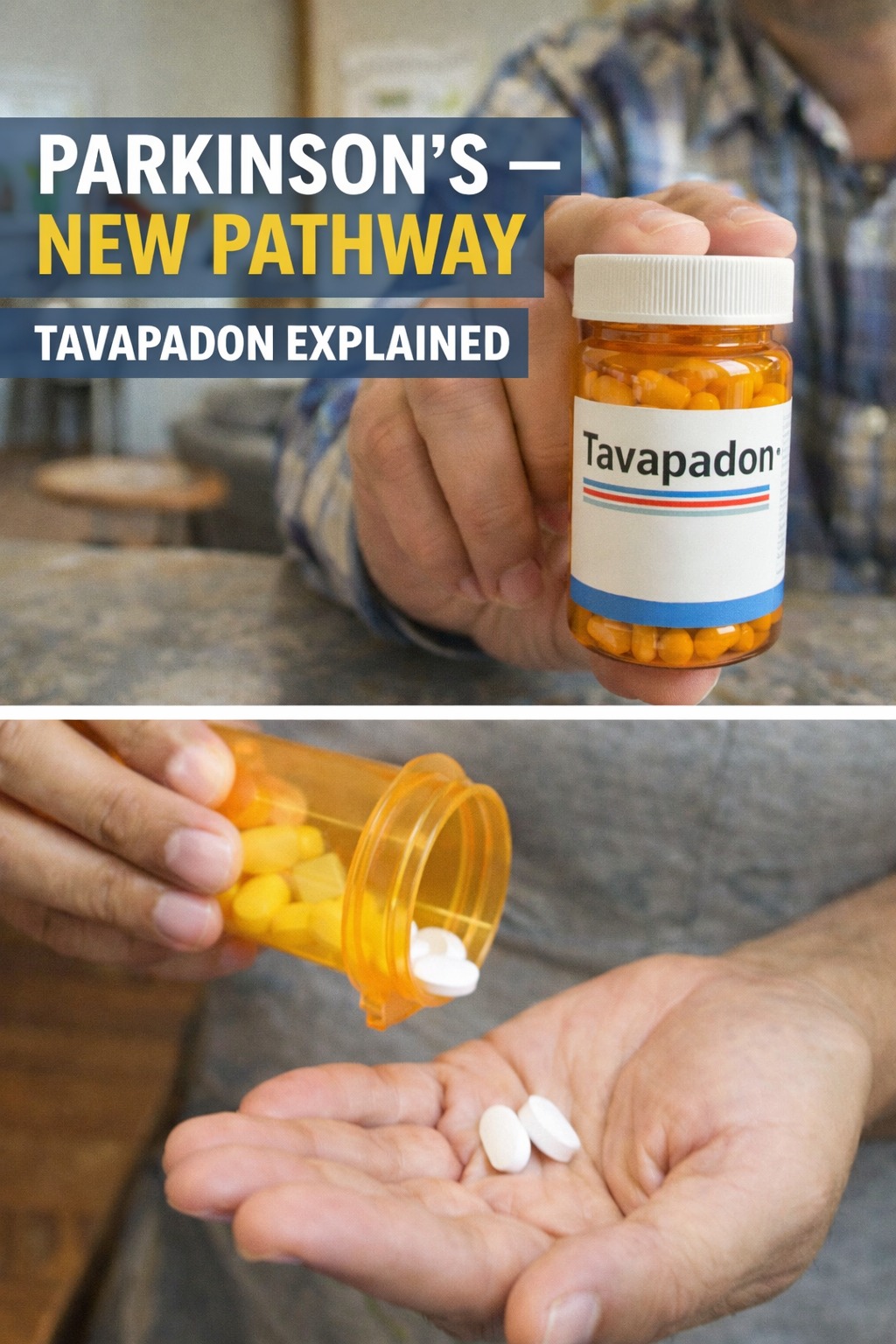
How Tavapadon Works: A Selective New Pathway
Tavapadon is an investigational once-daily oral medication developed as a selective partial agonist at the D1 and D5 dopamine receptors. Unlike many existing dopamine agonists that primarily activate D2 and D3 receptors, tavapadon targets the D1/D5 family, which plays a key role in the brain’s “direct pathway” for initiating and smoothing movement.
Think of it like this: the brain has multiple dopamine “switches.” Traditional agonists press several at once, which can overstimulate certain areas and contribute to side effects. Tavapadon aims to activate specific switches more gently and selectively as a partial agonist, meaning it provides a balanced signal rather than full-on stimulation.
Research from the TEMPO clinical trial program (including TEMPO-1, TEMPO-2, and TEMPO-3) explored this mechanism in both early and more advanced Parkinson’s. Studies showed improvements in motor function scores and daily “on” time when tavapadon was used alone or added to levodopa. One notable finding was an increase of about an extra hour of good symptom control per day in some participants using it alongside levodopa, with many side effects described as mild to moderate.
But that is not the full story yet. The selective approach also appears to result in lower rates of certain D2/D3-related issues like impulse control disorders or excessive sleepiness in the trial data, though individual experiences vary and more real-world use will provide additional clarity.
Key Findings from Clinical Studies
The TEMPO trials involved hundreds of participants and delivered consistent insights:
In early Parkinson’s (TEMPO-1 and TEMPO-2), tavapadon as monotherapy led to meaningful improvements in motor symptoms and daily activities compared to placebo, as measured by standardized scales.
In people already on levodopa with motor fluctuations (TEMPO-3), adding tavapadon increased “on” time without troublesome dyskinesia and reduced “off” time.
Long-term follow-up data suggested sustained benefits for many participants over months, with a safety profile that researchers described as generally favorable.
Common side effects reported across studies included nausea, headache, and dizziness. These were mostly mild to moderate, and serious events occurred at rates similar to or slightly higher than placebo in some trials. Importantly, hallucinations and impulse control issues remained comparable to placebo levels, which aligns with the drug’s more targeted receptor profile.
Here is a simple comparison to help illustrate the differences:
Traditional dopamine agonists (mainly D2/D3 focused): May help motor symptoms but sometimes linked to sleepiness, compulsivity, or leg swelling.
Tavapadon (D1/D5 selective partial agonist): Aims for motor support through the direct pathway with once-daily dosing and potentially fewer D2/D3-related effects based on trial observations.
Levodopa: Effective but often requires multiple daily doses and can contribute to fluctuations over time.
This table is for educational purposes only—your doctor will determine the best approach for your specific situation.